
By WANG HONGYI
wanghongyi@chinadaily.com.cn
As the progress of traditional medical solutions such as drugs and surgery have slowed, the advanced technology of stem cell therapy has been hailed as the new way to repair or replace damaged cells and overcome diseases.
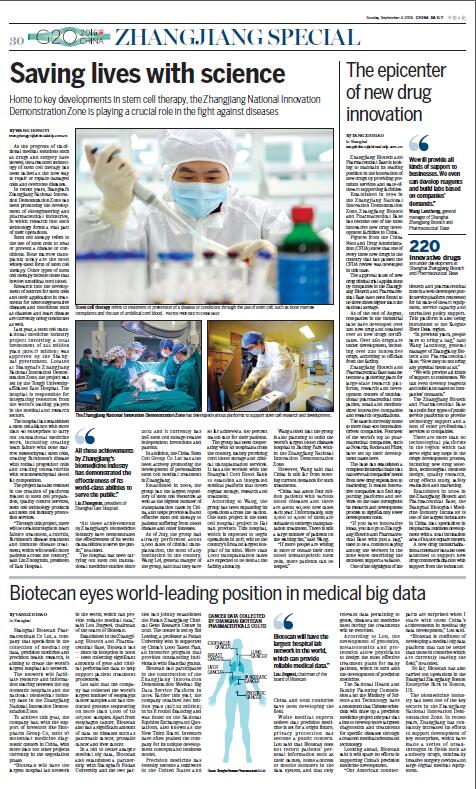
In recent years, Shanghai’s Zhangjiang National Innovation Demonstration Zone has been promoting the development of bioengineering and pharmaceutical industries, in which research into such technology forms a vital part of their operations.Stem cell therapy refers to the use of stem cells to treat or prevent a disease or conditions.
Bone marrow transplants today are the most widely-used form of stem cell therapy. Other types of stem cell therapy include those that involve umbilical cord blood.
Research into the development of sources for stem cells and their application in treatments for neurodegenerative diseases and conditions such as diabetes and heart disease are currently being conducted as well.
Last year, a stem cell translational medicine industry project involving a total investment of 255 million yuan ($38.17 million) was approved by the Shanghai government. Located at Shanghai’s Zhangjiang National Innovation Demonstration Zone, the project was
led by the Tongji Universitya ? liated East Hospital. The hospital is responsible for integrating resources from the world’s leading players in the medical and research sectors.
The hospital has established a stem cell alliance with more than 40 enterprises to carry
out translational medicine work, including treating heart failure with bone marrow
mesenchymal stem cells, treating Parkinson’s disease with retinal progenitor cells
and treating osteoarthritis with ectomesenchymal blood fat composition.
The project has also resulted in the creation of platforms related to stem cell preparation,quality control services, stem cell technology products and stem cell industry promotion services.
“Through this project, there will be breakthroughs in heart failure treatment, arthritis,Parkinson’s disease treatment and immune disease treatment, which will benefi t more patients across the country,” said Liu Zhongmin, president of East Hospital.
All these achievements by Zhangjiang’s biomedicine industry has demonstrated the e" ectiveness of its world-class abilities to serve the public.”
Liu Zhongmin, president of Shanghai East Hospital
“All these achievements by Zhangjiang’s biomedicine industry have demonstrated the e" ectiveness of its worldclass abilities to serve the public,”he added.
The hospital has been carrying out stem cell translational medicine studies since 2012 and it currently has 296 stem cell storage-related independent inventions and patents.
In addition, the China Stem Cell Group Co Ltd has also been actively promoting the development of personalized stem cell medical treatment in Zhangjiang.
Established in 2004, the group has the largest repository of stem cell resources as well as the highest number of transplantation cases in China, and helps provide safe and e" ective stem cell therapy to patients su" ering from blood disease and other illnesses.
As of July, the group had already performed about 2,000 cases of clinical transplantation, the most of any institution in the country.
Wang Lei, general manger of the group, said that they have so far achieved a 100 percent
match-rate for their patients.
The group has been cooperating with 83 hospitals across the country, mainly providing cord blood storage and clinical transplantation services.
It has also worked with the Shanghai Cord Blood Bank to establish an integrated medical platform that covers regular storage, research and treatment.
According to Wang, the group has been expanding its operations across the nation.
One such project is the stem cell hospital project in Hai nan province. This hospital,
which is expected to begin operations in 2017, will be the country’s fi rst and largest hospital of its kind. More than 1,000 transplantation cases are expected to be held at the facility annually.
Wang added that the group is also planning to build the world’s largest blood diseases
hospital in Jiading Park within the Zhangjiang National Innovation Demonstration Zone.
However, Wang said that China is still far from meeting current demands for such treatments.
“China has about four million patients with various blood diseases and there are about 40,000 new cases each year. Unfortunately, only 3,000 to 4,000 of them are suitable to undergo transplantation treatment. There is still a large number of patients on the waiting list,” said Wang.
“If more people are willing to store or donate their cord blood hematopoietic stem
cells, more patients can be helped.”